
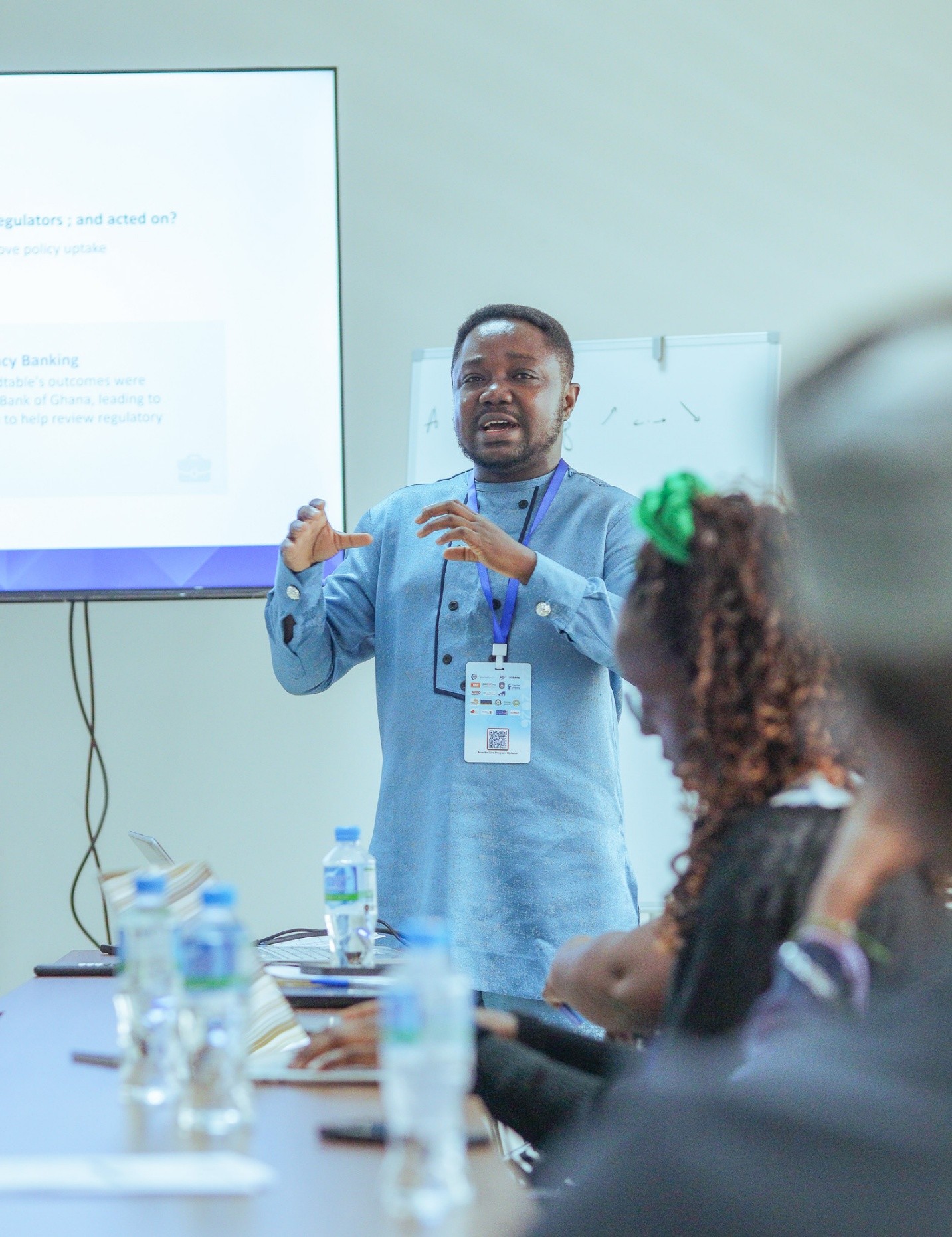

Researchers from the Retail Finance Distribution (ReFinD) initiative shared insights on how applied research can influence industry strategy and regulatory reform in Ghana’s digital finance sector at the 9th Evidence to Action (E2A) Conference and Exhibition 2026 (E2A2026).
The presentation, delivered by Executive Director Prof. Peter Quartey and Post-doctoral Fellow Dr Daniel Osafo during the Private Sector Evidence-Based Decision-Making (EBDM) Lab, was titled “Beyond the Report: How Applied Research Shapes Industry Strategy and Regulatory Reform in Ghana’s Digital Finance Sector.” The session focused on evidence use in business decisions, impact investing, agriculture, climate, the digital economy, and MSME growth, providing a platform to explore how research can move beyond academic outputs to become evidence that industry actors and decision-makers actively seek and use.
Drawing on recent experiences, the presenters showed how ReFinD's research has contributed to decision-making beyond traditional academic outputs. Following the Bank of Ghana's 2025 directives on digital lending regulation, MobileMoney Limited (MML) engaged ReFinD to examine the directives' implications using loan portfolio data, stakeholder interviews, and regulatory insights. Findings from the study were presented at MML's Fintech Stakeholders Forum and developed into a strategy document for its leadership. The engagement also supported discussions around the development of a Digital Asset Bill and led to further engagement between ReFinD and MML’s senior management.
The team also drew on an industry roundtable ReFinD convened to examine challenges facing Ghana's agency banking sector, including fraud risks, liquidity constraints, and agent productivity. Recommendations from the engagement were submitted to the Bank of Ghana, leading to ReFinD's participation in a regulatory workshop reviewing agency banking guidelines.

Together, the two experiences underscored the importance of generating evidence that is timely, relevant, and responsive to the decisions facing industry and policymakers. The presentation highlighted that effective evidence-to-action pathways require credible research, meaningful stakeholder engagement, and sustained partnerships between researchers, regulators, and industry actors.
As part of the conference's technical sessions, ReFinD researchers also contributed to a Transformational Lab, engaging participants on strengthening evidence-informed decision-making and advancing research that responds to development priorities across Africa and beyond.
The engagements formed part of the 2026 Evidence to Action Conference and Exhibition (E2A2026), held from 22–26 June 2026 at the Institute of Statistical, Social and Economic Research (ISSER), University of Ghana. Organised by the International Centre for Evaluation and Development (ICED) in collaboration with ISSER, the Partnership for African Social and Governance Research (PASGR), the Research and Evaluation Centre (REC), and other partners, E2A2026 was held under the theme "Re-imagining the Evidence-Informed Policy and Decision-Making Ecosystem in Africa."
The gathering brought together researchers, policymakers, development practitioners, civil society organisations, and other stakeholders from across Africa to advance the use of locally generated evidence in shaping policies and development interventions.
Through its participation, ReFinD reaffirmed its commitment to producing and promoting actionable research that strengthens the link between evidence generation, policy dialogue, and practice in Ghana’s financial sector.